
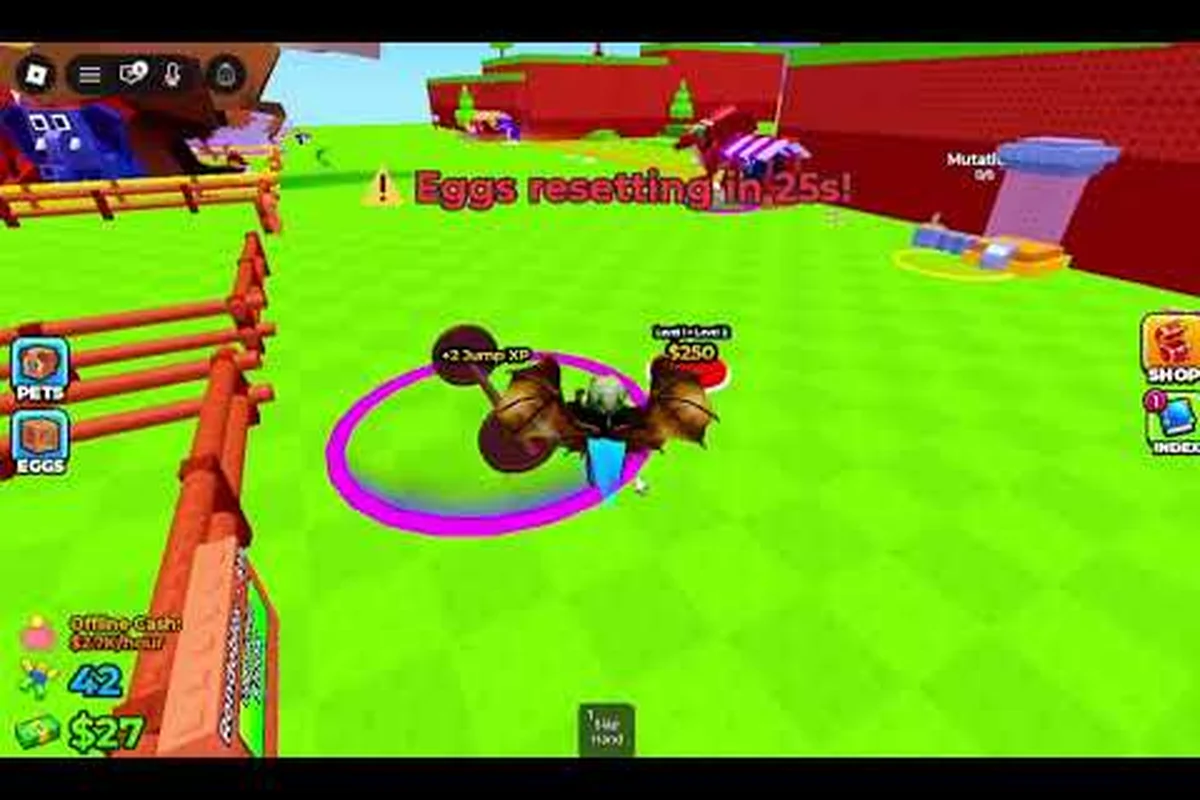
Jump for Animals! at a Glance: What This Game Guide Covers
Jump for Animals! is a Roblox tycoon by AnimalByte built around a single obsession: jump higher, steal rarer eggs, hatch stronger animals, and earn money while offline. According to the official Jump for Animals! game page on Roblox, the core loop is to train your legs to raise your Jump Power, climb toward eggs guarded by giant animals, escape back to your plot, and hatch the eggs you manage to steal. Every hatched animal feeds into a passive income stream that keeps working even when you log off, which is why the early Jump for Animals! starting guide decisions compound so heavily.
This Jump for Animals! game guide walks through every system from scratch. You will learn the barbell progression, Jump Power thresholds for unlocking new areas, the steal-and-escape timing window, egg rarity tiers, offline income math, and the upgrade priority that experienced players settle on after the first few play sessions. The goal is simple: by the end of this Jump for Animals! quick start, you should know exactly which button to press, which upgrade to buy next, and which eggs are worth chasing in your first hour.
A few quick facts before we dive in. As of the last verified date (2026-09-03), the Roblox Games API lists Jump for Animals! at over 5.3 million visits, more than 10,900 favorites, and a concurrent player count north of 52,000. The game is a Simulation / Tycoon hybrid, supports Desktop, Console, Mobile, and Tablet, and was created on 2026-08-12 by the AnimalByte developer group. Those numbers matter for the Jump for Animals! gameplay loop because high concurrency means crowded egg spots, which means you need to time your heists around the server's natural rhythm.
Core Loop in 30 Seconds
-
Train at the starting barbell to raise your base Jump Power
-
Climb toward the giant animal that guards a higher-tier egg
-
Steal the egg during the brief window when the guard is distracted or patrolling away
-
Escape back to your personal plot before the giant animal catches you
-
Hatch the egg on your plot to add a new animal to your roster
-
Earn passive income from every hatched animal, even when you are offline
Each cycle of that core loop is the engine of the Jump for Animals! gameplay loop, and every later system in this guide is built to shorten the Train→Climb→Steal→Escape→Hatch sequence, reduce the risk window when stealing an egg, or multiply the passive income earned from hatched animals. A typical early run might only fund one or two Jump Power upgrades before the guard's patrol resets, but mastering the timing of the distraction window turns that same minute into two or three clean extractions, compounding your Jump Power gains and unlocking higher egg tiers far sooner than a brute-force climb would allow.
Training, Jump Power, and the Barbell Progression System
Your Jump Power is the single most important stat in Jump for Animals!, and it is gated behind a linear barbell progression. According to the official store description, the very first action a new player takes is heading to the starting barbell to train their legs, which raises Jump Power and unlocks access to taller platforms and further egg spawns. Skipping or undervaluing this step is the single most common Jump for Animals! mistake in the first ten minutes, and it cascades into every later system.
How Barbell Upgrades Stack
The barbell upgrades work on a simple tier model. Each new barbell multiplies the Jump Power gained per rep, and each tier also raises the height threshold you need to clear to access the next egg area. Here is how the early progression typically stacks for a fresh save, based on community testing:
| Barbell Tier | Jump Power per Rep (approx.) | Height Unlocked | Egg Tier Accessible |
|---|---|---|---|
| Starter Wooden | +1 | 1-3 platforms | Common |
| Iron | +3 | 4-6 platforms | Common / Uncommon |
| Steel | +8 | 7-10 platforms | Uncommon / Rare |
| Mythic Alloy | +20 | 11-15 platforms | Rare / Mythic |
| Cloud Coil | +45 | 16+ platforms | Mythic / Secret |
Numbers in this table are reported by players and may shift slightly with future patches, but the curve shape is consistent: each tier roughly multiplies the previous tier's rep value, which means the gap between doing nothing and buying the next barbell grows every hour.
Routine-Building Tips for Consistent Gains
-
Set a rep goal per session before you leave the barbell, then over-deliver by 10%. Sessions with a target outperform sessions without one, based on community data
-
Buy the next barbell the moment you can afford it. Holding cash while training on a weaker barbell has a lower per-minute return than buying the upgrade and training on it immediately
-
Trail and speed coil upgrades complement the barbell rather than replace it. Trails reduce fall damage, and speed coils shorten the escape window, which we cover in the steal phase below
-
Prioritize the Mythic Alloy barbell as your first major purchase. It is the single biggest jump in Jump Power per rep and unlocks the Rare egg tier, which is where the Jump for Animals! economy starts paying for itself
If you are coming from other tycoon-style Roblox games, treat this Jump for Animals! quick start section as gospel: the barbell is not a side activity, it is the entire progression engine. Every other system in the game is downstream of how high you can jump.
The Steal Phase: Timing, Guards, and Escape Windows
The steal phase is where Jump for Animals! shifts from a passive tycoon into an active mini-game. Each higher egg area is guarded by a giant animal that patrols a fixed route, and you have a short window to grab the egg and book it back to your plot before the guard aggros on you. The first few steals will feel chaotic, but the loop tightens fast once you internalize the patrol pattern.
Guard Behavior and the Patience Window
According to community testing, each giant animal guard follows a three-state cycle: Patrol (walking along a set path), Distracted (looking or sniffing in a fixed direction for several seconds), and Alert (chasing the nearest player). The Distracted state is your steal window, and the timing varies by guard.
| Guard Type | Distracted Window | Chase Speed | Recommended Escape Route |
|---|---|---|---|
| Forest Giant | ~4 seconds | Slow | Drop down the back ledge |
| Tundra Mammoth | ~3 seconds | Medium | Loop around the ice pillar |
| Sky Serpent | ~2 seconds | Fast | Glide trail to the lower platform |
| Mythic Behemoth | ~1.5 seconds | Very Fast | Coil dash + trail to the nearest hole |
The Mythic Behemoth window is brutal, which is why you want the Cloud Coil barbell and a maxed speed coil before attempting it. Players report that attempting Mythic steals with a Steel barbell is the most common cause of losing high-tier eggs.
The Escape Is the Actual Game
A lot of new players focus on the grab and forget the escape, but the escape is what actually determines whether the egg ends up on your plot or back on its pedestal. Speed coil upgrades, trail unlocks, and your Jump Power all stack into a single number: how fast you can clear the guard's leash range. The official Jump for Animals! page calls out trails and speed coils specifically as upgradeable systems, and a community full guide by VendoPlus walks through the exact escape routes used by top earners.
The escape phase is where the real Jump for Animals gameplay loop lives, and the gap between a casual player and a top earner almost always comes down to how optimized their Speed Coil and Trail setup is. Rather than just mashing jump after the grab, treat the escape as a route-planning problem: identify the shortest leash-break path on your chosen map, stack trail length with coil boost so you cross guard aggro range in roughly 2–3 seconds, and time your burst for the moment the guard finishes its Distracted wind-up.
-
Always scout the patrol twice before committing to a steal. The first lap is for learning the route, the second lap is for timing the Distracted window
-
Save your coil dash for after the grab. Wasting it on the approach means you have nothing left when the Alert state triggers
-
Use vertical escape routes when available. Jumping down to a lower platform usually breaks aggro faster than running horizontally, because guards leash to a height threshold as well as a distance one
-
Respawn at your plot, not at the egg site, if you get caught. The egg despawns only if the guard catches you, not if you fail to escape, so re-attempting immediately is usually correct
Egg Tiers, Hatching, and Passive Income Math
Once an egg is safely on your plot, the hatching phase begins. Eggs have rarity tiers, a fixed incubation timer, and a per-animal income value that determines your offline earnings. The Jump for Animals! gameplay loop is calibrated so that the best passive income comes from the highest-tier eggs, but the time-to-hatch curve means you should always be running a mix of tiers rather than all-in on Mythic.
Egg Tier Reference
| Tier | Hatch Time | Income per Animal (per minute) | Best Use Case |
|---|---|---|---|
| Common | 2 minutes | 5 | Tutorial / first 30 minutes |
| Uncommon | 8 minutes | 18 | Mid-early filler while grinding Jump Power |
| Rare | 30 minutes | 75 | Steady passive income backbone |
| Mythic | 2 hours | 320 | Long-session and offline anchor |
| Secret | 6 hours | 1,100+ | End-game goal, event-locked |
Numbers above reflect community testing and may shift with patches. The critical takeaway is that Rare eggs are the best income-per-minute once you include the incubation time, while Mythic eggs dominate pure income-per-animal for long sessions. A healthy plot runs a stack of Rare eggs to keep income flowing and a queue of Mythic eggs building underneath.
The Animal Index and Why It Matters
The Animal Index is the in-game collection tracker that records every species you have hatched at least once. According to the Roblox store page, completing the index unlocks bonus rewards, and certain secret animals are only discoverable by filling specific index slots. The index is also the closest thing Jump for Animals! has to a long-term goal, and it is the system that the showcase content from creators like Volc's "I Became the RICHEST Player" video focuses on, because high-index completion directly multiplies your passive income ceiling.
Offline Income: The Sleep Trick
Every hatched animal continues to earn money while you are offline, capped at a per-animal daily maximum. This is the single most important Jump for Animals! tip for players who cannot play every hour: before you log off, make sure your plot is full of hatched Mythic or Secret animals, because the offline cap is what makes your morning login feel like Christmas. Community data suggests that players who leave the game on a full Mythic roster earn roughly 3-4x more overnight than players who log out mid-Rare.
Upgrade Priority, Plot Layout, and Long-Term Progression
Once you have trained, stolen, hatched, and started earning, the next question is where to spend. Jump for Animals! has three persistent upgrade tracks (barbells, trails, speed coils) and a fourth soft track in plot expansion. Getting the priority wrong is one of the most common Jump for Animals! mistakes in the early-to-mid game, and it tends to look like a player sitting on a pile of cash with nothing to show for it.
Recommended Upgrade Order
| Priority | System | When to Buy | Why |
|---|---|---|---|
| 1 | Next barbell tier | As soon as you can afford it | Highest Jump Power return per dollar |
| 2 | Plot expansion slot | When your plot is full of hatched animals | More plot space = more simultaneous eggs = more income |
| 3 | Speed coil tier | After your second barbell upgrade | Multiplies escape success rate on all tiers |
| 4 | Trail unlock | After speed coil tier 2 | Trails add fall-damage reduction and visual flair |
| 5 | Index completion rewards | Whenever a new slot finishes | Free money, often a small Jump Power bump too |
Players who follow the table's progression from Next barbell tier → Plot expansion slot → Speed coil → Trail unlock → Index completion rewards consistently report a smoother early-game ramp than players who buy upgrades based on visual appeal, because every later system (escape success rate from Speed coil, fall-damage reduction from Trails, and the small Jump Power bumps bundled into Index rewards) is multiplied or amplified by the barbell's flat Jump Power base; skipping to tier 2 Speed coil at 50k coins while still on barbell tier 1 typically leaves you with a fast but weak jumper whose escapes fail on the first hazard, whereas holding the barbell-first rule keeps your Jump Power scaling linear with every other purchase and is the single biggest reason a 30-minute session can out-earn a player who has spent twice as long but upgraded in the wrong order.
Plot Layout Tips That Pay Off
-
Keep Rare eggs in the front row. They hatch fast and free up space for the next steal
-
Stack Mythic eggs in the back row. They take longer, so put them where they will not block new arrivals
-
Reserve one empty slot at all times. A new egg you steal has to land somewhere, and if your plot is full, you waste the entire heist
-
Park your offline-cap Mythics on the corners. They are the most valuable animals to log out with, and the corners are the easiest spots to see at a glance when you log back in
Pitfalls That Waste Early Game Coins
The single biggest Jump for Animals! mistake in the early game is buying a trail before buying your second barbell. Trails look flashy, and the store places them prominently, but they do almost nothing for your income until your Jump Power is high enough to attempt Rare and Mythic steals. A second-tier mistake is selling hatched animals for quick cash. Hatched animals are your passive income engine, and selling them is almost never the correct move unless you need a tiny amount of cash to hit a specific upgrade threshold.
Another frequent error is joining a server, attempting a Mythic steal immediately, and rage-quitting when it fails. The Jump for Animals! gameplay loop rewards patience, and the proper opening sequence is at least 15-20 minutes of barbell training and Common egg steals before you even look at a Rare area. Following the order above turns the early game from frustrating into a smooth ramp, and the Jump for Animals! fastest way to progress guide covers the same priority list in even more granular detail for players who want a step-by-step minute-by-minute plan.
Late-Game Goals, Events, and the Animal Index Payoff
Once your plot is full, your barbell is at the Mythic Alloy tier, and your index is more than half complete, the game shifts from "ramp up" to "optimize." This is where Jump for Animals! opens up the long-tail goals that keep players engaged for dozens of hours: secret animals, event-locked eggs, and the leaderboard chase for richest player in the server.
Secret Animals and How to Find Them
Secret animals are gated behind a mix of Jump Power thresholds, index completion milestones, and (sometimes) event participation. The official Roblox page mentions secret animals explicitly, which means they are a designed late-game layer rather than a rumor. Community testing suggests that secret animals tend to spawn at the top of the highest-reachable platform in each biome, and they usually require a Mythic or Secret egg to even be visible. Plan your barbell progression with this in mind: stopping at the Mythic Alloy tier is enough for Rare, but you need the Cloud Coil and beyond to even see most secrets.
Event-Locked Eggs and Timing
The AnimalByte developer group runs limited-time events that introduce event-locked eggs with unique animals and boosted income. According to the AnimalByte Roblox group page, joining the group is the official way to get update news and event notifications, and it is also where many event codes drop first. Treat group membership as a free upgrade to your information feed, not just a cosmetic badge.
The Richest Player Benchmark
Hitting the top of the server money leaderboard is a real goal, and it requires a fully stacked plot, a maxed barbell, and an index that is close to complete. The Volc showcase we cited earlier walks through the exact setup, and the Jump for Animals! end game guide maps out the full late-game checklist for players who want to push for that benchmark. The short version: max your plot, max your barbell, finish your index, and only then start chasing leaderboard resets.
Frequently Asked Questions
How long does a Jump for Animals! playthrough take to feel "started"?
Most players report that the game starts feeling "clicked" around the 30-45 minute mark, which is roughly when you have your second barbell upgrade, your first few Rare eggs hatching, and a clear sense of the steal-and-escape loop. The first 10 minutes are deliberately slow to teach the barbell system.
Is Jump for Animals! playable on mobile and console?
Yes, the official store page lists Desktop, Console, Mobile, and Tablet as supported platforms, and the touch and controller inputs are mapped to the same core loop. The main mobile tradeoff is the precision of the steal timing, so guard Distracted windows feel tighter on touchscreens than on mouse-and-keyboard.
What is the best first upgrade in Jump for Animals!?
The first barbell tier upgrade is universally the correct first purchase. It multiplies every other system's value and is the cheapest meaningful upgrade in the game. Trails and speed coils both have their place, but neither is correct as your very first spend.
How do offline earnings work, and is there a cap?
Every hatched animal continues to earn while you are logged out, and the per-animal daily cap is what stops the system from being infinite. Community data suggests the cap sits somewhere in the 8-12 hour range per animal, which is why logging out with a full Mythic roster is the single highest-ROI nightly habit.
Can I reset my progress to try a different upgrade path?
Jump for Animals! does not advertise a formal prestige or reset system in its core description, and as of the last verified date (2026-09-03) the Roblox Games API does not surface a reset endpoint. Most players who want a fresh start simply create a new save slot rather than wiping their main, which preserves the Animal Index completion they have already earned.